Undisovered Amerindians

Undisovered Amerindians
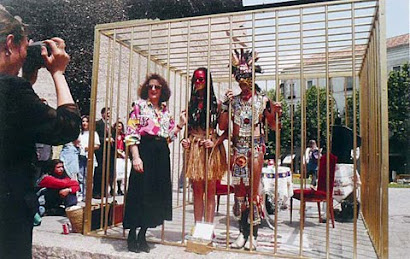
In order to address the widespread practice of human displays, Fusco and Gomez-Peña enclosed their own bodies in a ten-by -twelve-foot cage and presented themselves as two previously unknown "specimens representative of the Guatinaui people" in the performance piece "Undiscovered Amerindians." Inside the cage Fusco and Peña outfitted themselves in outrageous costumes and preoccupied themselves with performing equally outlandish "native" tasks. Gomez-Peña was dressed in an Aztec style breastplate, complete with a leopard skin face wrestler's mask. Fusco, in some of her performances, donned a grass skirt, leopard skin bra, baseball cap, and sneakers. She also braided her hair, a readily identifiable sign of "native authenticity."

Tuesday, March 2, 2010

Felix Gonzalez-Torres

Felix Gonzalez-Torres combined the impulses of Conceptual art, Minimalism, political activism, and chance to produce a number of "democratic artworks"--- including public billboards, give-away piles of candies, and
stacks of paper available to the viewer as souvenirs. These works, often sensuous and directly audience-centered, complicate the questions of public and private space, authorship, originality and the role of institutionalized meaning.

"Untitled (Portrait of Ross)"

The work of Felix Gonzalez-Torres calls attention to the exhibition space as well as the economy of the art object. To many of his installations, the viewer’s participation is important to the work- the audience is invited to take pieces of candy or sheets from a stack of paper- this depleting of the stack or pile becomes a metaphor, in some cases referring to the passing of time or of life's impermanence.

Gonzalez-Torres has set up a unique system for any gallery or museum curator who decides they would like to exhibit his work. Curators, who have obtained ownership of a Felix Gonzalez-Torres piece, have signed a contract with the now deceased artist. Due to the unique character of the work of Gonzalez-Torres, a certificate of authenticity and ownership accompanies each work. These certificates include a balance of specific guidelines for recreating and maintaining the works while at the same time an open-endedness that leaves space of interpretation.


Perhaps the most well known works of Gonzalez-Torres are the Candy pieces. In exhibiting a piece like
"Untitled" (Placebo),
the certificate cites the original candies used for the piece. He instructs:

“If the exact candy is not available, a similar candy may be used... A part of the intention of the work is that third parties may take individual candies form the pieces. The individual candies, and all individual candies taken from the piece collectively, do not constitute a unique work nor can they be considered the piece.” “The owner has the right to replace, at any time the quantity of candies necessary to regenerate the piece back to its ideal weight.”

In the image on the left, volunteers and the staff at the Williams College Museum of Art install "Untitled" (Placebo).

Williams College Museum of Art Presents

Felix Gonzalez-Torres "Untitled" (Placebo), 1991
December 1, 2007-March 23, 2008

I found an interesting article that describes the installation process of “Untitled (Go-Go Dancing Platform), 1991. Here's an excerpt from the article:

Call it the artistic opposite of a still life: Guyton had to find a living, breathing, moving performer to be part of an artwork for the show — a re-creation of the late Cuban artist Felix Gonzalez-Torres’ 1991 installation “Untitled (Go-Go Dancing Platform).”

“It was the strangest installation process I’ve ever had,” Guyton says of his search through bars in West Hollywood and Silver Lake, adding slyly, “But it was enjoyable, of course.”

For pieces like Untitled (North), 1993 Gonzalez-Torres states that the owner can install the piece how ever they would like, and it may be installed differently each time. He only asked that they try to replace burned out bulbs with the exact or a similar bulb if possible.

Coco Fusco

 
Coco Fusco is a prolific multimedia artist, writer, and professor. She holds a B.A. from Brown University in Literature and Society/ Semiotics, and M.A. in Modern Thought and Literature from Stanford University, and a PhD in Art & Visual Culture from Middlesex University. She is Cuban-American, and race and international relations feature heavily in her work. 

Coco has a huge, varied, and impressive body of work, but for this particular exploration, I will choose a few works to concentrate on that struck me as pertinent to this course. I will first say that her website is quite extensive, and is comparable to an online museum in and of itself. Many of her works are cataloged and well organized, with extensive descriptive texts to accompany them. Coco is not the type of artist who wants to hide her intentions or research - this information is shared quite freely, and invites her audience to join her in her subject matter, as a museum might do, rather than keep us at arms length. 

 The first work I will focus on is a 1997 performance titled Better Yet When Dead. For this piece, Coco transformed the gallery into a funeral parlor, casting herself as the mourned, and holding wakes while taking on the persona of various deceased female cultural figures. The inspiration for this piece came in response to the media sensation following the death of Selena. This led Coco on a train of thought which explored the trend of such sensation. Coco wonders "why Latino cultures in the north and south are so fascinated with female creativity once it has been forever silenced". She found other examples which fit her theory, including Ana Mendieta, Cuban film maker Sara Gomez, and Frida Kahlo, who only after violent or unexpected deaths did their work receive a heightened level of acclaim. 
I found this to be an interesting subversion, within the very same institutional walls that played into these shifts in attention. Holding a wake for a dead artist in a gallery space that also acclaims the dead artist, rather than giving that same recognition to the living female artist. 

The next work I would like to bring up is a performance titled Rights of Passage. Originally conceived as a site-specific performance for the Johannesburg Biennial in 1997, the piece addresses "race, space and power in the post-apartheid era". It takes into account the specificity of existing in a museum in a couple different ways. Firstly, Coco dons museum security guard attire. In the entryway of the museum, she arranged a station from which to distribute passbooks, replicas of the passbooks forced upon Africans in apartheid times to show when entering white areas. These particular passbooks served as proof of payment for museum entry, an artwork, and a documentation of the performance. Five-thousand copies were made and distributed. I believe that this commodification of such a historical reference works on multiple levels, including contemporary peoples relationship to the past, the souvenir aspect of historical references, as well in bringing into question how racial discrepancies exist within museums.


Lastly, I'd like to briefly touch upon another performance Coco did in collaboration with Juan Pablo Ballester and Maria Elena Escalona at the 1997 ARCO Latino Art Fair., titled Sudaca Enterprises. While not directly a museum-based work, I believe this performance still holds important guerrilla relationships with the "art world" as a larger entity than just the museum. For this performance, the three sold t-shirts at the art fair, without paying the fee for a booth, and were ejected multiple times. First for not paying, second for not selling from an unofficial booth, and lastly for wearing masks to obsure their identities. "The t-shirt text compares and contrasts the price of Latin American art in Europe and the cost of selling it at ARCO with the cost of surviving as an undocumented Latin American immigrant in Spain". Nonetheless, all the t-shirts they made sold, and at least two are now in museum collections. In a sense, the same basic governing body (the institutionalized art world) that expelled them from the art fair later condoned and encouraged this rogue behavior, like an inconsistent parent sending it's child mixed messages of approval and denial. 

Overall, I would say that Coco Fusco works amiably with, and within, museums. I do not believe her intent is to cast them in a negative light, despite her subversion. I believe she is an incredibly thoughtful and intelligent woman, and such a mind cannot avoid reexamining the artist/museum relationship, and she does so sharply.   


Monday, March 1, 2010

Groupe de Recherche d'Art Visuel (GRAV)

1960-1968

“Are we researchers? Are we still artists? What should our relations be with galleries and museums?”


“…by founding the Group, we were deciding to leave aside the personal problems and ambitions of each one of us in favour of systematic research. We were reckoning on pooling a sum of concepts and research which would no longer owe anything to the whims of personal inspiration. At the same time we denounced the cult of personality and the speculation in which art and artists were the stake. We were keen to restore a certain conception of the public that had been devalued by obscurantist art criticism, which considered that art only addresses the elite.

To do this we planned to escape from the traditional gallery circuit, but to stay in touch with the public as closely as possible so as to change the existing situation.” (248)


MANIFESTO (1966)
We are particularly interested in the proliferation of works which permit of varied situations, whether they engender a strong visual excitement, or demand a move on the part of the spectator, or contain in themselves a principle of transformation, or whether they call for active participation from the spectator. To the extent that this proliferation allows the calling in question – even diffidently – of the normal relations between art and the spectator, we are its supporters. But this is only a first stage. The second might be, for example, to produce, no longer only the works, but ensembles which would play the part of social incitement, at the same time as liberating the spectator from the obsession with possession. These “multipliable” ensembles could take the form of centres of activation, games rooms, which would be set up and used according to the place and the character of the spectators. From then on, participation would become collective and temporary. The public could express its needs otherwise than through possession and individual enjoyment.

MANIFESTO (1967)
For this Group, the introduction of light is neither an advance nor an end in itself. Its use varies according to the situations presented: variations, progressions, reflections, transformations of structures, projections, revolving lights, neons, all have been used separately in isolated situations (luminous boxes, grids, or neons, for example) or integrated in mazes or halls.
This Group is not concerned to create a work having light as its subject, nor to produce a super stage-performance, but through provocation, through the modification of the conditions of environment, by visual aggression, by a direct appeal to active participation, by playing a game, or by creating an unexpected situation, to exert a direct influence on the public’s behaviour and to replace the work of art or the theatrical performance with a situation in evolution inviting the spectators participation.

How do you put pictures in the blog post?

hello friends. I am inexperienced. Please someone tell me how to put the pictures in the post, rather than above, below, or beside it. Thanks you! heart, LW

Gillermo Gomez-Pena and La Pocha Nostra


Guillermo Gomez-Pena and his collaborative team La Pocha Nostra create interactive “living museums” that parody various colonial practices of representation including the ethnographic diorama, the Freak Show, The Indian Trading Post, the border “Curio Shop”, the sex shop/strip joint window, etc. They exhibit themselves as human artifacts within diorama environments. They focus on border politics and the brown body as “savage”, but with a ton of wry wit. The work manifests through interactive performances. The group composes their identities as “¼ stereotype, ¼ audience projection, ¼ aesthetic artifact, and ¼ unpredictable personal/social monster.”

Did you know I asked to have GGP and then by chance I picked him out of the hat? It was meant to be. I didn't even know so much about the museum oriented work. I recommend to anyone interested in identity, the idea of the border, progressive politics, performance art and gender bending to check out GGP further. He also hosts a summer workshop on performance. I have personally seen a few recent performances of La Pocha Nostra, most recently a guided tour of the Mission district, on the Mexican Bus, a colorful San Francisco tradition. It featured Guillermo’s prerecorded guided docent tour over speakers while fellow performance artist Violeta Luna performed and interacted with many of the locations. The passengers/audience could choose to either stay and watch or step out on the street with her and interact with the environment. Locations were “where the hipsters hung out” to the old colonial mission, to a junkie and mural filled alley.

Below is a very pieced together autobiographical timeline, written in Guillermo's voice, which is very flavorful. I have edited it way down (simply because it is 18 pages) to leave mainly GGP’s development of identity as a performance artist, and works that relate to museums. The entire timeline is an excellent read and can be found at www.hemisphericinstitute.org


1971: The Normal de Maestros student massacre takes place a few blocks away from my home. I write and perform Smogman, a sci-fi piece based on one of my first alteric selves, an activist super-hero who fights against pollution in Mexico DF. The third act includes a museum of “things past” with purified water, plants, and taxidermied extinct animals. These ideas will re-surface in my work years later.

1978: I receive a scholarship to study at the California Institute of Arts. I cross the US- Mexico border in search of artistic fresh air and my lost Chicano family. I suddenly become … brown, a “wetback,” a “beaner,” a “greaser.” I do not know the implications of these words. I begin my process of Chicano-ization with the unsolicited help of the LA police. I walk from Tijuana to Cal Arts in two and a half days, my head covered with gauze. I wear my father’s suit and carry a briefcase containing my passport, talismans and a diary.

1979: The Loneliness of the Immigrant. Part I. I decide to spend 24 hours in a public elevator wrapped in batik fabric and rope, a metaphor for a painful birth in a new country, a new identity as “the Chicano,” and a new language, intercultural performance. It’s my first performance “documented” by the art world.
The Loneliness of the Immigrant Part II. I spend 12 hours lying on the downtown LA streets as a Mexican homeless person. Despite the fact I am wrapped in a serape and surrounded by candles, most people ignore me. I discover that as a Mexican (and a "homeless" person), I am literally invisible to the Anglo Californian population. Performance is my strategy for becoming visible. The first Mexican financial crack occurs and our family’s savings evaporate. My father advises me not to return to Mexico. ”Stay in Southern California and wait for better times,” he says. The wait turns out to be the rest of my life. I am still waiting …

1985: BAW/TAF’s strictly artistic activities help to protect our backs and legitimize our more activist work. In addition to art shows, publications, radio programs, and town meetings, we organize performance events right on the borderline, where the U.S. meets Mexico in the Pacific, literally performing for audiences in both countries. When the border patrol gets too close, we cross to the Mexican side. During certain performances, we invite our audiences to cross "illegally" to the other side. We exchange food and art "illegally,” caress and kiss "illegally" across the border fence, and confront the border patrol in character. We are protected by the presence of journalist friends and video cameras. The political implications
of the site and the symbolic weight of these actions garner immediate attention from the international media. These are the origins of the border arts movement.

1985: I begin The Velvet Hall of Fame, a long-term collaboration with traditional velvet tourist painters from Tijuana who reinterpret my performance characters. The process is very matter of fact; the more I pay, the better the painting is, period. They don't care about reviews or openings, but they get a kick out of my madness. My “conceptual velvet art” project will last for a decade, during which time I get to exhibit these paintings at the Walker Art Center, the Detroit Institute of Arts, the Corcoran Gallery, and MACBA (Barcelona). When I see these paintings hanging within walking distance of a Gauguin or a David Salle, I somehow feel historically vindicated. I love to cross the border between “high” and “low” art.

1988-89: My main contribution to the performance monologue movement is Border Brujo, a spoken word monologue dealing with border identity. The script is written in English, Spanish, Spanglish, gringoñol and various made up "robo-languages." My portable altar, which functions as set design, as well as my hand-made costumes, are composed of "pseudo-ethnic" objects, tourist tchotchkes and cheap religious souvenirs. With Border Brujo I become a migrant performance artist, spending two years on the road, going from city to city, from country to country and back, reproducing the migratory patterns of the Mexican Diaspora. As I travel, I incorporate new texts, props and costumes into the piece. The project is documented in two videos by filmmaker Isaac Artenstein. The Brujo and I end up back at the US-Mexico border in late 1989 where I bury his costume and props and stage his performance funeral. I receive both a New York “Bessie award” and the “prix de la parole” from the International Theater Festival of the Americas (Montreal). I am suddenly propelled into the center of the art world, and my personal life becomes extremely complicated.

1991: I move to New York to live with Coco and to work on the first part of my trilogy, The Re-discovery of America by the Warrior for Gringostroika, at the Brooklyn Academy of Music’s Next Wave Festival. One day, during rehearsal, I get the magical phone call announcing that I am a “MacArthur Genius.” Two months later, my ex-wife sues me, taking half of my fellowship in court, and some of the original members of BAW/TAF suggest that I split the other half amongst the group. I ask myself: “Is this my true birth ritual into the American art world?”

1992: Artists such as Fred Wilson, Adrian Piper, James Luna, and Jimmy Durham begin to interrogate the way museums represent cultural otherness and start a dialogue with radical anthropologists. I begin to experiment with the colonial format of the "living diorama." My collaborators and I create interactive "living museums" that parody various colonial practices of representation including the ethnographic tableau vivant, the Indian Trading Post, the border curio shop, the porn window display and their contemporary equivalents. These performance/ installations function both as a bizarre set design for a contemporary enactment of "cultural pathologies," and as a ceremonial space for people to reflect upon their attitudes toward other cultures.

1992-93: During the heated debates surrounding the Columbus Quincentenary, Coco Fusco
and I decide to remind the US and Europe of "the other history of intercultural performance,” the sinister human exhibits, and pseudo-ethnographic spectacles that were so popular in Europe from the 17th century until the early 20th century; at the turn of the century in the US, they transformed into more vulgar exhibits like the dime museum and the freak show. In The Guatinaui World Tour, Coco and I live for three-day periods inside a gilded cage as "undiscovered Amerindians" from the (fictional) island of Guatinau (Anglicization of "what now") in the Gulf of Mexico. I am dressed as an Aztec wrestler from Las Vegas and Coco as a taina straight out of Gilligan's Island. We are hand fed by fake museum docents and taken to public bathrooms on leashes. Taxonomic plates describing our costumes and physical characteristics are placed next to the cage. We tour the US, Europe, Australia, and Argentina. Sadly, over 40% of our audiences believe the exhibit is real yet they do nothing about it. The most drastic audience response is from an Argentine military man who throws acid on me during the performance in Buenos Aires. The tour is chronicled in the film Couple in the Cage.

1993: I start a long-term collaboration with Native American artist James Luna. In The Shame-man Meets El Mexi-can't at the Smithsonian Hotel and Country Club, Luna and I share a diorama space at the Museum of Natural History. I sit on a toilet dressed as a mariachi in a straightjacket with a sign around my neck announcing, "There used to be a Mexican inside this body." I unsuccessfully attempt to get rid of my straightjacket while James paces back and forth, changing identities. At times he is an "Indian shoe-shiner," at other moments he becomes a "diabetic Indian" shooting insulin directly into his stomach. He then transforms into a janitor of color (like most janitors in US museums) and vacuums the diorama floor. Hundreds of visitors gather in front of us. They are sad and perplexed. Next to us, the “real” Indian dioramas speak of a mute world outside of history and social crises. Next to us, they appear much less “authentic.” While rehearsing the 2nd part of our project , James lights up some sage. The security guards phone the DC police and we get busted in the dressing room for “smoking pot.” Furious with such a ludicrous claim, curator Aleta Ringlero calls museum administration demanding an apology on our behalf. For James and me, such a situation is just a good anecdote. As James put it, “simply one more day in the life of an Indian and a Chicano.” We reenact the bust in a series of photos.

1994-96: Roberto and I tour Temple of Confessions, a performance/ installation combining the format of the ethnographic diorama with that of the religious dioramas found in colonial Mexican churches. For three-day periods, we exhibit ourselves inside Plexiglas boxes as "end-of-the-century saints.” Those visitors who wish to “confess” their intercultural fears and desires to us have three options: they can either confess into microphones placed on kneelers in front of the boxes (their voices are recorded and altered in post-production to ensure their anonymity), or, if they are shy, they can write their confessions on cards and deposit them in an urn. If they are extremely shy, they can call an 800 number. The "confessions" are quite emotional and intimate. They range from confessions of extreme violence and racism toward Mexicans and other people of color, to expressions of incommensurable tenderness and solidarity with us, or with our perceived cause. Some are filled with guilt or fear, fear of cultural/political/sexual invasion, violence, rape, and disease. Other confessions are fantasies about escaping one's identity: Anglos wanting to be Mexican or Indian or vice versa, self-hating Latinos wanting to be Anglo or simply "blond." There are also many descriptions (both real and fictitious, but equally revealing) of intercultural sexual encounters. By the end of the third day, we leave the Plexiglas boxes and are replaced by human-sized wax effigies. The Temple of Confessions remains as an installation piece for eight weeks, and written and phone confessions continue to be accepted. The project is documented in a PBS documentary, a radio documentary for NPR, and a book (Power House, NY) with the same title. The last performance of the tour takes place at the Corcoran Gallery of Art in Washington DC.

1995: I move to San Francisco and begin the long-term project of tattooing my torso and arms. Nola Mariano and I found La Pocha Nostra. The objective is to create a loose interdisciplinary association of rebel artists interested in collaboration. Inspired by zapatismo, our collaborative model of concentric and overlapping circles functions both as an act of civic diplomacy and as a means to create “ephemeral communities” of like-minded artists. We are more of a conceptual laboratory than a company, a strategic gathering of politicized artists thinking together, exchanging ideas and aspirations. We begin a fruitful binational exchange project with Mexican performance artists titled Terreno Peligroso/Danger Zone. It’s a good time for Mexican and Chicano artists to collaborate. We create a Free Art Agreement, an ongoing exchange of ideas and artwork, and begin to collaborate across the border. I begin my long-term association with the National Public Radio program, All Things Considered. I write and record a monthly commentary from the position of a performance artist. I suddenly have a national voice in a society in which mainstream media covers artists either as celebrities, human-interest stories, or social monsters but rarely as intellectuals.

1997: The art world begins to talk about “relational aesthetics.” Radical choreographer Sara Shelton Mann from the dance troupe Contraband, Roberto, and I jumpstart a three-year project titled The Mexterminator. The idea is to use the internet as a tool of “reverse anthropology” to research America's psyche regarding Anglo/Latino relations, then to develop an ever-evolving repertoire of performance personae based on this research. For this purpose, we develop “confessional” websites asking individuals to suggest how we should dress as Mexicans and Chicanos, and what kind of performance actions and social rituals we should engage in. The Internet confessions are much more explicit than those gathered during live performances such as Temple of Confessions. Scholars help us to select the most striking and representative confessions so we can use them as source material for performance. As performance artists, we embody this information and re-interpret it for a live audience, thus refracting fetishized constructs of identity through the spectacle of our artificially constructed identities on display. A gorgeous photo-portfolio by Mexican photographer Eugenio Castro is made out of the Mexterminator personae. At least 500 of these images haven’t yet been printed or published.

1999: I marry gorgeous Colombian curator and writer Carolina Ponce de León. Our loft in San Francisco becomes an informal roadside museum, salon and hostel for Mexican,
Colombian, US and European artists who pass through. A local TV station does a reportage on the house calling it “the Smithsonian of the barrio.”

1999-2002: The new Pocha Nostra troupe tours The Living Museum of Fetishized Identities internationally. The next step in our performance research is to develop large- scale interactive performance/installations that function as “intelligent raves and art expos of Western apocalypse.” Every “living museum” is site-specific and involves a different group of local artists. Live music, video and computer projections, cinematic lighting, taxidermied animals and twisted ethnographic motifs help enhance our high-tech “robo-baroque aesthetic.” In these intoxicating environments, we exhibit ourselves on platforms as intricately decorated “ethno-cyborgs” and “artificial savages” for 3 to 5 hours a day. The structure is open and non-coercive, allowing the audience to walk around the dioramas designing their own journey. They can stay for as long as they wish, come in and out of the space, or return later on, fully participating in our performance games or keeping to the sidelines as voyeurs. In the first hour, the experience is typically voyeuristic. The “ethno-cyborgs” create slow motion tableaux vivants that sample and combine radical political imagery, religious iconography, extreme pop culture, fashion and theatricalized sexuality. The audience members are confronted with a stylized anthropomorphization of their own post-colonial hallucinations, a kind of cross-cultural poltergeist in which the space between self and other, “us and them,” fear and desire, becomes blurry and unspecific. As the evening evolves, the experience becomes increasingly participatory. We include a diorama station where audience members can choose a “temporary ethnic identity” and become “their favorite cultural other” using make-up and costumes provided by us; after this, they are encouraged to integrate themselves into our living dioramas. Both audience members and performers make political, ethical and aesthetic decisions on the spot. In this sense, the performance becomes an exercise in radical democracy. In the last hour, we step out of the dioramas and cede total control to the audience, as the post-colonial demons dance all around us.

2001: The US experiences on its own soil its worse terrorist attack ever. The neo-cons in power rapidly transform the country into a closed society ruled by paranoid nationalism and fear. An unprecedented era of censorship for artists and intellectuals begins. This climate forces La Pocha to spend more than half of the year outside the country, becoming Chicano expatriates abroad. We begin to compare notes with Arab and Persian artists based in the US and the UK regarding the demonization of the brown body.

You can find many performance texts and much more at www.pochanostra.com
And video footage at http://www.vdb.org/

Sunday, February 28, 2010

Two Naked Men Jump into Tracey's Bed

Tracey Emin's  My Bed, exhibited in the Turner Prize show at The Tate, 1999


Yuan Chai and J J Xi are Chinese born, British educated performance artists who are known for their interventionist performance of jumping on Tracy Emin's bed while it was on exhibition at The Tate.  

During their performance they took off their shirts and jumped around on the bed. They had various "ism" written on their body including: "Internationalism", "Freedom" "Anarchism", "Idealism", "Optimism",  and "Anti-Stuckism"

Chai & Xi said that they thought Emin's piece was strong, but institutionalized, and that they wanted to "improve" it -"We are simply trying to react to the work and the self-promotion implicit in it."

Visitors to the exhibit at that moment said, "Everyone at the exhibition started clapping as they thought it was part of the show. At first, the security people didn't know what to do."

News Media often dismissed Yuan Chai and J J Xi as "art students", but they were practicing artist and  43 and 37 years old respectively at the time. 

They continue to make performances together under the name Mad for Real. Other performances have included putting up fake signs to mislead visitor trying to get to the Venice Biennale, and attempting to reclaim Duchamp's urinal for it's original function, which they reportedly failed to do but possibly caused the museum to enclose the piece in a vitrine.


Performances by Cai and Xi use the body as an agent between historical, geographical and institutional frameworks. The unspoken barriers of cultural protocol, class, taste and national loyalty are all dissolved in their work but the appeal of much of their 1999–2005 projects still lies, ironically, in its Britishness. It is the specific cultural references, the focus on larger symbolic aspects of British culture and their absurdity, which makes it accessable to a broader public – a public which is not ensconced in the narrow elitism of the art world. The My Bed intervention, which launched them into the public eye six years ago, was a classic moment of British popular culture, which has become insinuated into institutions of British life such as University Challenge and Have I Got News for You. The bed incident is regurgitated by the press when the Turner Prize comes round year after year. Ironically, this work is democratic. By being critical, it opens a conversation with both the establishment itself and with ‘foreigners’, young people and those outside of the mainstream.                  -Katie Hill

Friday, February 12, 2010

Oregon Martime Museum

I visited the Oregon Maritime Museum on a Sunday afternoon. I had seen the old steam boat from bridges crossing the Willamette, but had never really noticed this entrance until I went looking for it. It seems to be one of those thresholds that one wouldn't cross without intent...not entirely inviting as a walk-in type of place, although during my visit, some people did prove me wrong by doing just that.


Upon entering, you walk down a ramp and board the ship, with no immediate greeting. I followed some laminated signs until I entered the main deck of the ship, which was converted into a small gift shop, and a display area for various artifacts. I wasn't sure what to expect on this museum-boat hybrid, but it did in fact have some "exhibition" qualities to it.

As soon as I entered, I was greeted by the two volunteers on duty that day. One at the register, one at the ready to give me a tour, despite the fact that I was the only one there. I thought that was pretty nice. The docent's name was Charlie and he was clearly passionate about this boat. That was a reoccurring theme through out my visit - the museum has no issue getting volunteers, because people are very passionate about it's history and it's future. It is completely volunteer run, and Charlie told me that there are roughly 100 volunteers, about 50 of which are considered "active". This includes both docents and other "museum people" as well as a number of certified steam engineers who still work on the mechanical aspects of this boat to keep it in running condition. While it is usually docked, it still runs, and hits the river a couple times a year.

Just as Charlie started up my tour, some other people trickled in and were invited to join us. During my span on the boat, I mostly saw families with small children, although Charlie told me they can't really pin down their "type" of visitor. The tour consisted of a balance between historical background, addressing of the artifacts on the main deck, and quite a bit of the ship itself. I found this to be a very interesting concept as far as museums go - the space that holds the "museum" also being a part of it..an artifact in and of itself.

There was a very personalized touch to the tour. Charlie was very open to answering questions. He told me in our one on one conversation later that he finds it very important to emphasize the ship itself, as well as the dedicated "river pilots" who still come in twice a week and keep her running. There seems to be a fissure between the attitudes of the "museum folk" and the old guys working on the engine downstairs. They each see the boat as theirs. He also noted that we live in "such a litigious society that it's a bear to keep a captain", although the boat is certified to sail with 100 passengers.


The presence of those river pilots is felt, despite their literal absence that day. Their coffee mugs hang in a break area, their chairs still arranged for meeting. There was really no sectioning off between those "living" sections of the boat, and those meant more for display. The entire lower deck holds the engine, and we spent just as much time down there as we did looking at ship models and old divers helmets upstairs.

When I asked Charlie what he thought the museum needed, one of his first off the cuff responses was "We really need someone who speaks Spanish" as a docent. He then went on to explain to me that the institute of the museum actually owns many many more artifacts than it has space to show on this boat. He told me there was once a mainland component, but that now much of the collection lies in a basement storage facility somewhere. They want to move the boat to Centenial Mill, and convert that space into a larger museum to showcase their collection, but as is expected, they have funding problems there. They receive no state funds, so they rely entirely on the small admission fees and donations. Charlie told me that they do get some contributions from large local corporations as well, from time to time. I personally think they could use a more informative website, but other than that, I understand the limitations they face.

I think the most striking part of my experience, besides spending 3 hours speaking with Charlie and the other very nice volunteer, Davey, was the moment I was about to leave. Three visitors came through the door with service dogs - all three were blind. As I thanked the volunteers for their time, Charlie set out to give a tour to the blind visitors, addressing the more "tactile" features. I was unexpectedly moved by this...the fact that the museum COULD still be interesting to these visitors on information and tactility alone, and that Charlie did so without hesitation.


-Jillian


Oregon Maritime Museum
http://www.oregonmaritimemuseum.org/
$5 for adults ($1 off with AAA membership)
Located on the westside of the Willamette between the Morrison and Burnside Bridges
Wednesday - Sunday 11:00am - 4:00pm

Monday, February 8, 2010

Please add your Mueum presentations

Hi kids,
Please post your fabulous museum presentations here so we can all enjoy them. Perhaps a narrative blog post and a few pics?
Thanks-

Sunday, February 7, 2010

Welcome to Museum Museum

Welcome. This is a blog to archive the research & findings of Mark Dion's Museum Museum class at PSU, Winter/Spring 2010. Feel free to add content, authors.